Purr-Powered Tempo: How Indie Producers Are Using Cat Frequencies to Find Their Perfect BPM
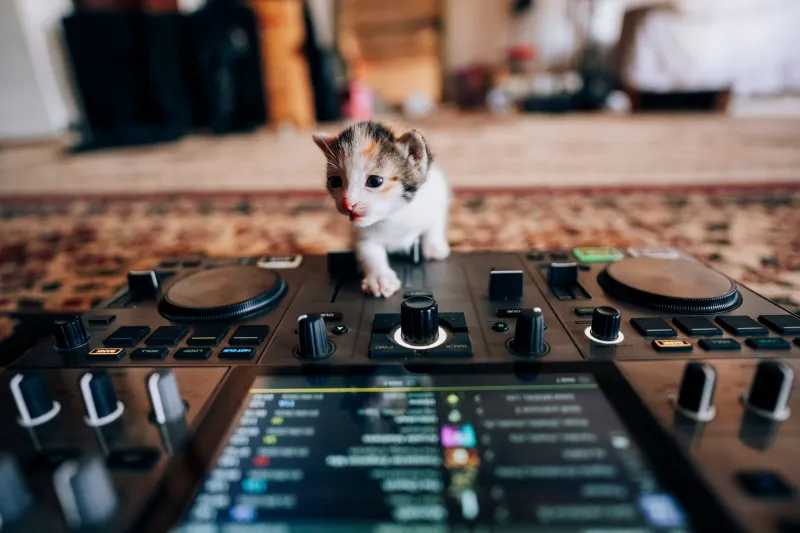
There's a metronome click that's been around for thousands of years, and it doesn't need batteries. It doesn't need a power outlet. It doesn't even need a smartphone app. It just needs a warm lap and a bowl of wet food.
We're talking about the cat purr — and indie producers across the country are quietly turning this ancient feline frequency into one of the most unexpected production tools in modern music.
The Number That Keeps Coming Up
Here's where things get genuinely interesting. Domestic cats purr at frequencies ranging from roughly 25 to 50 Hz, with the most common baseline sitting right around 25 Hz. That number might not mean much on its own, but when you start cross-referencing it with what neuroscientists know about human brainwave activity, something clicks.
The brain's theta wave state — that dreamy, deeply focused headspace that most creatives describe as "the zone" — operates between 4 and 8 Hz. Alpha waves, associated with relaxed alertness and open creative thinking, run from about 8 to 13 Hz. A purring cat doesn't land directly in those ranges, but the low, rhythmic vibration it produces has been shown in several small studies to promote relaxation and reduce cortisol levels in humans nearby. Less cortisol means less mental noise. Less mental noise means you're making better decisions at the board.
For producers who've spent years chasing that elusive flow state, this is a pretty significant detail.
From Accident to Workflow
Most of the artists who've incorporated purr frequency into their process didn't exactly set out to run a scientific experiment. It started by accident — a cat jumped into the studio setup, stayed put, and suddenly the session felt different.
Take Marcus Delray, a lo-fi and indie soul producer out of Atlanta who records under the name Sundial Drift. He's been making beats out of his spare bedroom for about six years. His cat, a gray tabby named Copernicus, has been a fixture in his sessions almost since the beginning.
"I didn't think about it analytically for a long time," Marcus told us. "I just noticed that my best sessions — the ones where I'd look up and three hours had passed — almost always had Copernicus somewhere close. Sitting on the desk, curled up behind the monitor. Purring."
It wasn't until Marcus started obsessing over why certain sessions felt cohesive and others felt scattered that he made the connection. He'd been reading about binaural beats and low-frequency sound therapy, and something lined up. "The purr is doing something to your nervous system," he says. "It's grounding you without you even realizing it."
The BPM Alignment Theory
Here's the part that's gotten producers especially curious. A cat purring at 25 Hz produces roughly 25 cycles per second. Convert that to beats per minute — which is just cycles per minute — and you're looking at 1,500. That's not a usable BPM on its own, but divide it down by factors of two and you start landing in real territory: 750, 375, 187.5, 93.75.
That last number? Suspiciously close to 94 BPM, which sits right in the sweet spot for mid-tempo soul, indie pop, and a huge swath of lo-fi hip-hop. Divide once more and you're at roughly 47 BPM — a tempo that shows up constantly in ambient and slower beat-driven music.
Now, nobody's claiming this is a hard formula. But producers who work intuitively — who choose tempos by feel rather than grid — are noticing that sessions with a purring cat nearby tend to produce tempo choices that cluster around these same ranges. Whether that's coincidence, confirmation bias, or something genuinely acoustic is still an open question. But it's a question worth asking.
Jasmine Tran, who produces indie electronic music under the alias Feltwork in Portland, Oregon, has been keeping loose notes on her session tempos for the past two years. "I went back through my project files and looked at the BPMs on everything I made during my good sessions versus my frustrating ones," she says. "The good ones were almost all between 88 and 96 BPM. My cat Nori was almost always in the room for those."
She's careful not to overstate the case. "I'm not saying the cat is setting my tempo. I'm saying something about having her there puts me in a state where I make more decisive choices. I pick a BPM and I commit to it. I don't second-guess everything."
Reducing Creative Friction
That phrase — "I don't second-guess everything" — comes up a lot in these conversations. And it might be the most practically useful part of this whole discovery.
One of the biggest time sinks in solo production is decision paralysis. You've got a loop you like, you've got a rough tempo, and then you spend 45 minutes nudging the BPM up and down by single digits trying to find the "right" feeling. It's exhausting, and it rarely produces better results than just committing early and building around your choice.
The working theory among producers who've noticed the purr effect is that the low-frequency vibration essentially calms the part of your brain that keeps reopening closed decisions. It's not sedation — you're still alert, still creative. But you're less likely to spiral.
Marcus describes it as "the difference between working on a song and working against a song." When Copernicus is in the room, he says, the session has momentum. "I'm not going back. I'm just going forward."
Making It Part of the Routine
For producers who want to experiment with this but don't have a cat of their own, there are a few entry points. YouTube and Spotify have no shortage of "cat purring" ambient recordings, and some producers have started using these as background audio during the early stages of a session — before they've locked in a tempo or key — as a kind of warm-up for the nervous system.
Jasmine has gone a step further and actually sampled Nori's purr, pitching and stretching it into a low sub-bass texture that runs underneath several tracks on her upcoming EP. "It's not about the literal frequency at that point," she says. "It's more of a tribute. And also it sounds incredible."
For those with cats already wandering through their home studios, the advice is simpler: stop shooing them off the desk. Give them a spot near the monitors. Let the session breathe.
The Bigger Picture
What's interesting about this trend isn't just the science or the tempo math — it's what it says about how indie artists are approaching their creative environments. There's a growing awareness that the physical and emotional conditions of a session matter as much as the gear or the samples or the plugins. Temperature, lighting, time of day, the presence of another living creature — all of it shapes the work.
Cats, with their low-frequency purring and their complete indifference to deadlines, might just be the most effective ambient producers in the room. They're not trying to help. They're just existing. And somehow, that's exactly what the session needed.
Next time you're stuck on a tempo, maybe don't reach for the tap-tempo button. Reach for the cat instead.