Stalk, Stretch, Pounce: How Indie Musicians Are Letting Cat Behavior Write Their Song Structures
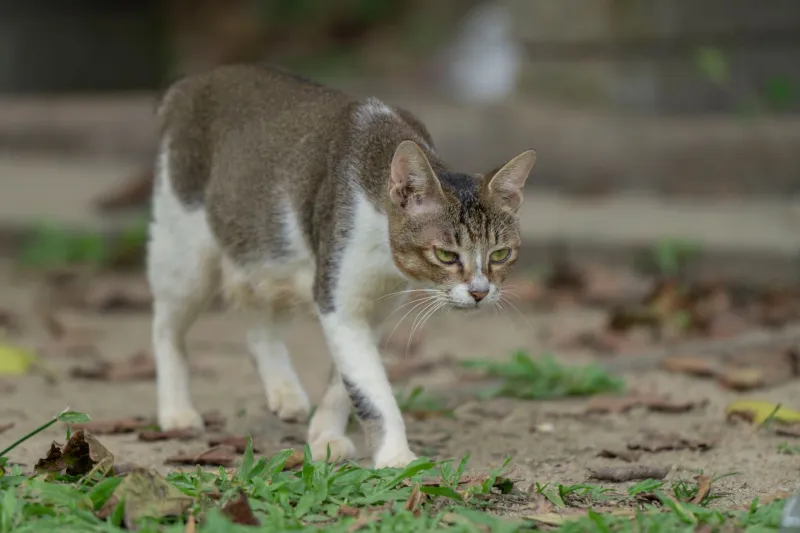
There's a moment every cat owner knows. Your cat spots something across the room — a dust particle, a shadow, a perceived threat to the entire household — and everything shifts. The body lowers. The tail twitches in this slow, deliberate rhythm. Then there's that electric pause right before the launch. And then: chaos, or grace, or both at once.
For a handful of indie producers across the US, that sequence isn't just adorable to watch. It's a compositional framework.
"I started thinking about it seriously when I noticed I kept abandoning songs that felt flat," says Marcus Webb, a lo-fi producer based in Portland, Oregon, who records under the name Soft Static. "My cat Noodle would be doing something completely mundane — like walking across the room to her food bowl — and there was just this inherent drama to it. A beginning, a buildup, a payoff. I was like, why don't my songs do that?"
Webb isn't alone. A loosely connected wave of independent artists is turning to feline behavioral patterns as a kind of organic template for song architecture — not in a gimmicky way, but as a genuine creative tool for understanding how energy moves through a piece of music.
The Hunting Sequence as Song Map
Cat behaviorists break down the feline hunting sequence into distinct phases: Orient, Stalk, Chase, Pounce, Grab, Kill, Eat, Groom. It's a complete arc with rising tension, a climactic moment, and a cooldown. Sound familiar?
Nashville-based producer Deja Fontaine, who works primarily in indie folk and ambient electronic, started mapping this sequence onto song structure after a conversation with a friend who studies animal cognition.
"She explained it as this ancient, hardwired narrative," Fontaine says. "And I immediately thought about how a great song does the same thing — it orients you, it builds, it releases, and then it settles. I literally drew the hunting sequence on a whiteboard and started arranging my tracks around it."
Fontaine's recent EP, recorded over six months in her home studio with her two cats Basil and Clementine nearby, uses the framework loosely but deliberately. The opening track begins with sparse, curious instrumentation — the "orient" phase — before layering in a slow rhythmic tension that mirrors a cat in full stalk mode. The drop, when it comes, isn't a traditional EDM-style beat switch. It's more of a controlled collapse, like a pounce that lands exactly where it was always going to land.
"People keep saying the songs feel 'inevitable' in a good way," she says. "That's the cat. That's the hunting sequence working."
Grooming as a Template for Repetition and Rest
Not every cat behavior maps to high-drama composition. Some of the most interesting applications come from the quieter stuff.
Chicago-based lo-fi artist Theo Kline — who records as Velvet Static — started paying attention to his cat's grooming rituals after reading about how repetitive self-care behaviors in cats serve a dual purpose: they're both calming and organizing. Cats groom in patterns, returning to the same spots, layering strokes in a way that's rhythmic but not mechanical.
"I was watching my cat Miso groom for like twenty minutes and I realized she kept returning to the same areas in this loose rotation," Kline explains. "It wasn't random, but it wasn't rigid either. That's exactly the kind of repetition I want in a beat — something that feels settled but never boring."
Kline applied this thinking to his hi-hat patterns and chord progressions, building tracks that cycle back to familiar elements the way a cat returns to the same patch of fur — with slight variations each time that keep the loop feeling alive rather than mechanical.
"Lo-fi is all about texture and return," he says. "Cats are basically masters of that."
The Slow Blink as Dynamic Tension
If you've spent any time around cats, you know the slow blink — that deliberate, half-lidded eye close that signals trust and ease. It's not nothing. It's a whole communication. And for some producers, it's become a model for how to handle a song's most vulnerable moments.
Austin-based singer-songwriter Priya Menon has been incorporating what she calls "slow blink moments" into her arrangements — sections where the music pulls back dramatically, stripping away layers to create a kind of held-breath intimacy.
"It's that feeling of trust," she says. "A slow blink from your cat means 'I see you, I'm comfortable, I'm choosing to be here.' I want certain moments in my songs to feel that way — like the music is choosing to be vulnerable with you on purpose."
Menon's approach has drawn comparisons to artists like Phoebe Bridgers and Snail Mail, both known for their ability to make sparse arrangements feel emotionally loaded. She's quick to credit her cat Saffron as an unlikely collaborator.
"Saffron has genuinely made me a better songwriter," she says, completely without irony.
Why This Works Beyond the Novelty
It would be easy to write this off as a quirky aesthetic — indie artists doing something cat-themed because cat content performs well online. But the producers involved push back on that framing pretty hard.
The underlying logic is actually sound. Cats evolved over millions of years, and their behavioral rhythms — the tension and release of the hunt, the meditative loops of grooming, the calibrated vulnerability of the slow blink — are patterns that feel "right" to human observers because they mirror fundamental emotional arcs that we recognize instinctively.
Music theorists have long talked about the importance of tension and release, of repetition with variation, of dynamic contrast. Feline behavior, it turns out, is a walking masterclass in all three.
"I'm not saying cats invented music theory," Webb says, laughing. "But I am saying that watching Noodle move through her day has taught me more about pacing than any YouTube tutorial I've ever watched."
Building Your Own Meow Meter
For producers curious about experimenting with this approach, the entry point is simpler than it sounds. Start by watching your cat — really watching — and noting the rhythm of whatever they're doing. How long does the buildup last before they act? Where does the energy peak? How do they settle afterward?
Then map those observations onto your arrangement. Where's your orient moment? Where does your stalk begin? Is your pounce landing where it should, or are you rushing it?
It's a different kind of reference track — one that lives in your apartment, probably knocking things off your desk.
But if the music these artists are making is any indication, it might be the most honest creative compass available. Cats don't do anything without a reason, and they never waste a movement. That's a pretty solid production philosophy, honestly.