Chew Marks, Crushed Faders, and the Duct-Tape Wisdom of Cat-Proofed Home Studios
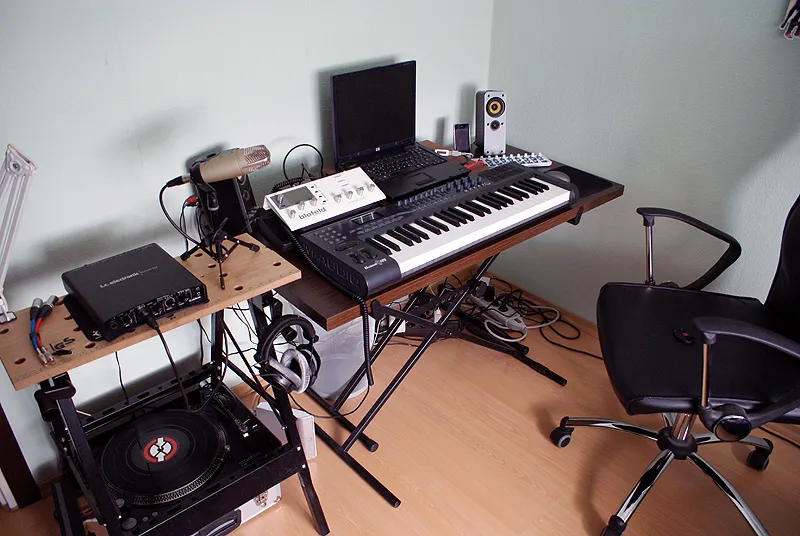
Photo: LiquidMolly, CC BY-SA 2.0, via Wikimedia Commons
Every home studio has a story about the day the cat found the patch bay. It usually starts with a small sound, the kind you barely register, and ends with you on your hands and knees at 11:40 p.m. untangling a 20-foot instrument cable from under a sofa while something furry watches with the calm of a landlord doing an inspection.
The truth is that your studio is not your studio. It is a shared apartment with a very small roommate who has no respect for your condenser mic and full authority over the warmest surface in the room. The producers who solve this fastest stop thinking in terms of discipline and start thinking in terms of design.
The Monitor Cone Incident
Dana Ruiz, who records dream-pop under the name Saltwater Kids out of Portland, Oregon, learned about foam grilles the hard way. Her cat, a hefty orange tabby named Otter, discovered that the soft cover over an 8-inch studio monitor made an excellent scratching post. Two cones later, she invested in something cheaper than replacement drivers: a pair of mesh laundry bags and a roll of gaffer tape.
"It looks ridiculous," she said. "But so does a $180 repair bill. I keep the grilles on when I'm not mixing, and I stopped buying speakers with exposed drivers. That's it. That's the whole system."
Ruiz now keeps a spare set of foam grilles in a drawer. She is not alone. Ask around any bedroom-producer Discord and you will find people who order grilles in pairs, the way other people buy guitar strings.
Cables and the Chew Economy
Cables are the number one casualty in cat-owning studios, and they fail in two ways: chewed through, or pulled out mid-take when a cat decides a dangling XLR is a toy on a string.
Illuminate, a producer in Asheville, North Carolina, runs cables through sections of corrugated plastic tubing behind her desk, then tapes down every loose run with gaffer tape. Total cost: under $20. The tape matters less for the chewing and more for the yanking. A cable that cannot move is a cable that stops being interesting.
A few practical notes from people who have been through it:
- Never leave a plugged-in cable where a cat can reach the connector end. Chewing a live cable is a genuine hazard, not just an annoyance.
- Bitterant sprays work on some cats and do nothing on others. Test on a spare cable before you coat anything you care about, and follow label directions.
- Keep two spares of your most-used cable lengths. The emotional cost of a dead cable at 9 p.m. before a deadline is much higher than the $15 it takes to avoid it.
- Loop and hang, don't coil on the floor. A cable on the floor is a cat toy. A cable on a hook is furniture.
The Keyboard Is a Heated Bed
The MIDI controller is the classic casualty, and it is almost never damaged by malice. It is damaged because it is flat, warm, and roughly cat-shaped.
Brooklyn producer Marcus Adeyemi solved this with what he calls the decoy rig: a broken 25-key controller that no longer sends MIDI to anything, sitting on a folded towel at the edge of the desk. His working keyboard lives on a sliding tray that gets pushed in when he steps away.
"Cats pick the spot that is already warm and already claimed," he said. "So I gave them a spot. The decoy gets used every single day. The real one gets used maybe twice a month by a cat, and only when I forget to push the tray in."
Other low-cost options: a silicone keyboard cover if you work with a laptop in the room, a hard shell case for anything you can close, and a simple rule that the gear gets covered before anybody leaves the room. Covers are annoying for about a week and then become muscle memory.
Vertical Space Beats Fences
The single most effective investment in most of these studios was not gear protection. It was a cat tree placed near the desk, ideally one with a platform at eye level so the cat can supervise.
The logic is simple. A cat that has somewhere better to be does not need to be discouraged from your desk. A cat with nothing to climb will climb your mic stand. Producers who added a shelf or a tree near the workspace reported far fewer incidents than producers who tried gates, sprays, or the spray bottle.
That last one is worth calling out. Punitive fixes do not work well with cats and tend to make a nervous animal more nervous, which is bad for a room where you are trying to record quiet things. The studios that stay calm are the ones that rearranged furniture instead of training a cat to have different instincts.
Mic Stands and the Laws of Physics
A boom stand with a $400 condenser on the end is a lever, and cats are excellent at finding the fulcrum.
Three things help: weight, height, and distance. Sandbags on the base of the stand, the boom arm kept short rather than fully extended, and mics stored in cases when not in use. One producer in Austin, Texas, hung a small brass bell on the counterweight of her boom so she could hear the stand shift from another room. It is not elegant, but it is cheap and it works.
The Twenty-Minute Reset
If you want a checklist you can run tonight, here is the one that keeps showing up in these conversations:
- Cover or case every mic when you leave the room.
- Tape down any cable that runs along the floor or dangles off the desk.
- Push the keyboard tray in and close the laptop.
- Put a decoy object, ideally warm, near the desk.
- Give the cat somewhere higher than the gear to sit.
- Keep the trash can lidded, because ribbon mic packaging and crinkle wrap are irresistible.
- Store small parts, adapters, and ear tips in a closed drawer.
The best cat-proofed studios do not look cat-proofed. They look like rooms where someone thought about where a small animal would want to go and put something there first. That is not punishment. That is just good studio design with an extra resident in mind.